4K video, color, sound, 3’31’’
48 digital prints on paper, handwritten,
14.8 x 10 cm each
pen, 16 digital prints on paper, 14.8 x 10 cm each
48 digital prints on paper, handwritten,
14.8 x 10 cm each
pen, 16 digital prints on paper, 14.8 x 10 cm each
"The exhibition brings together works that invite us to shift perspective on something already seen or known, to consider something anew, to reposition ourselves–or the work, to intensify our attention, to take the unfamiliar path, to find ways in which we can work through hardship, or even transmute it into joy. […] " — Alexandra Pirici
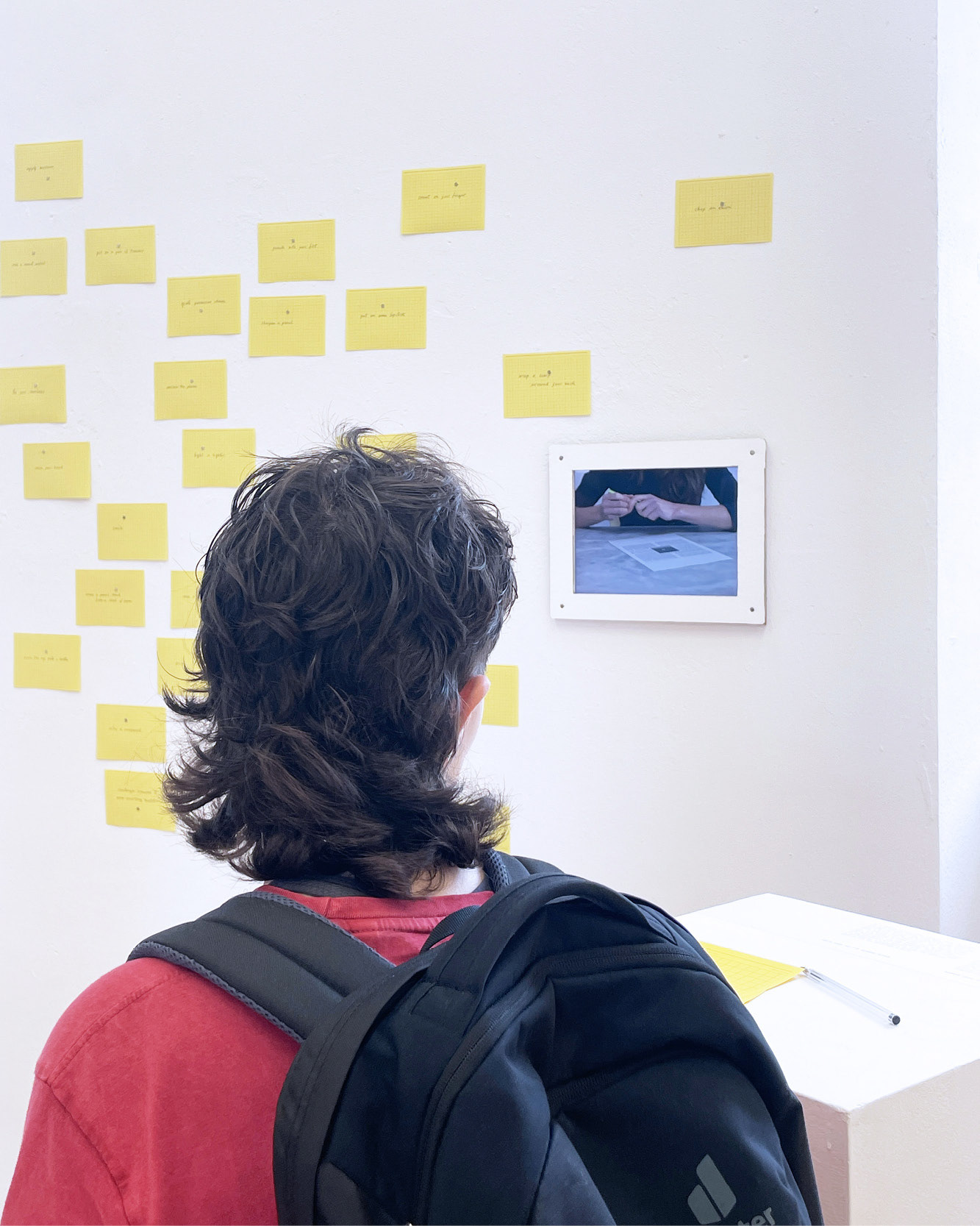
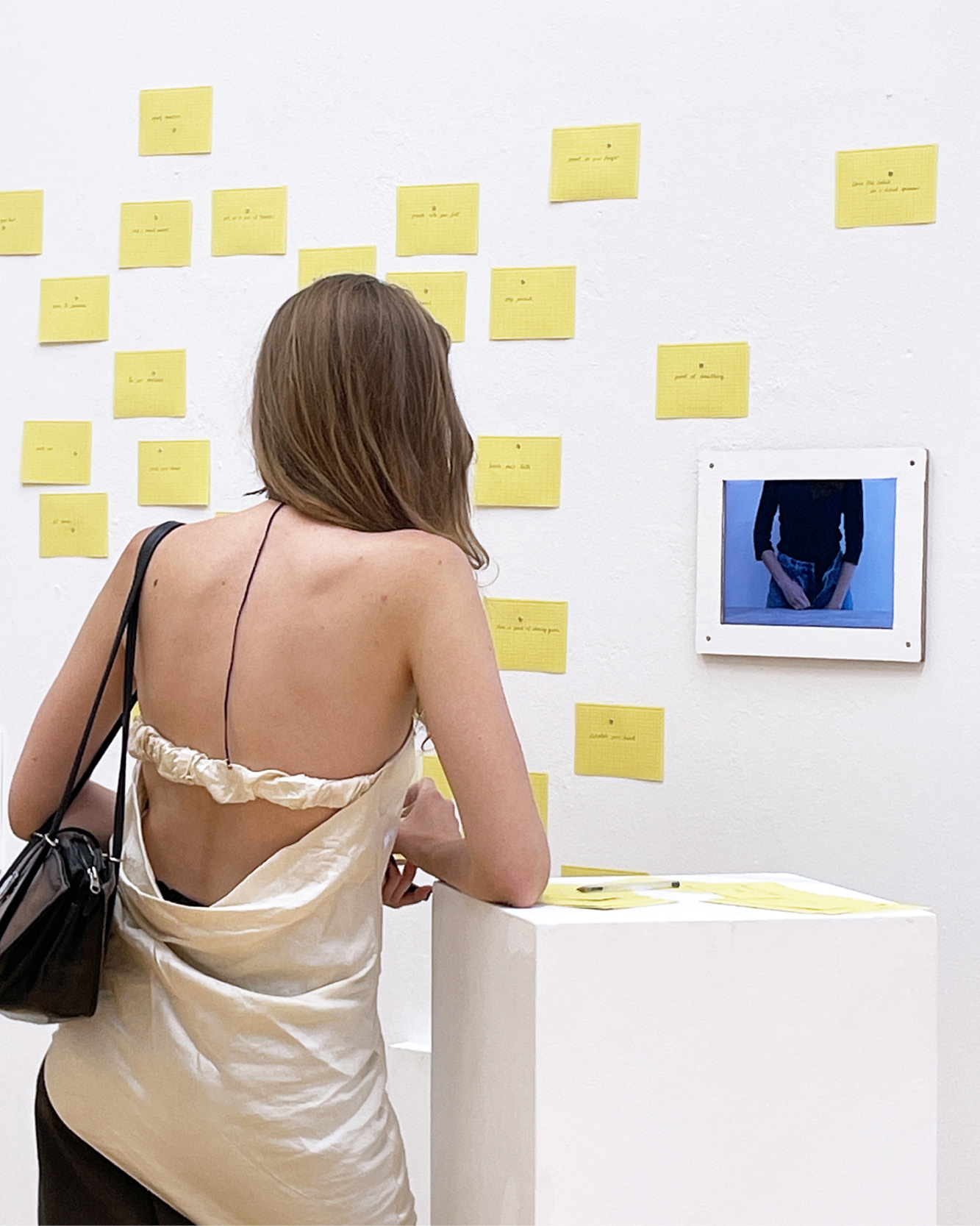
Reverse Actions explores daily habits by reversing the mechanics of everyday gestures. Through a video, a handwritten list, and sheets to fill, the artwork alters the relationship between movement and stillness. This inversion creates a discrepancy, a suspension between the expected gesture and the performed one.


The grammar of certain gestures was analyzed, and their key components were identified: see, for example, the action “the subject brushes their hair with a brush, moving the brush from top to bottom while keeping their head still.” The analyzed gestures were then replicated and revised by altering the fixed points and the expected, natural direction of the movements—for instance: “the subject brushes their hair by moving their head from bottom to top, keeping the brush still.”
The 15 actions shown in the videos do not evade functionality (the subject brushes their hair); indeed, the gestures do not lose their objective. However, by freezing what usually moves and moving what usually stands still, the mechanism appears tampered with, its quality altered. This inversion creates a discrepancy, a suspension between the expected gesture and the performed gesture. The body executing the “reversed” action loses its efficiency: force is poorly distributed, and precision is lost.
In the video, the actions are performed one after the other without any emotional embellishment, within a neutral frame: I am sitting in front of a white marble table, with a white wall behind me. I am dressed anonymously, wearing no makeup. No emotional involvement shows on my face. The concentration and lack of agitation required to execute these reversed actions reveal a mechanical component; an aura of error emerges, questioning the observer about the boundary between the artificial and the human.


Small sheets of paper are attached to the wall, on each of which a possible reversed action is handwritten. The characteristics of these sheets recall those of a notepad. The recorded actions are those that many of us perform throughout the day: putting on a pair of glasses, stirring coffee, throwing a piece of paper into the trash can.
Some of the written actions are performed and demonstrated in the video, while others are not. The latter, being “unresolved,” can be interpreted by the audience. The installation seeks to leave room for the viewers who, after reading a potential action, can test it, transforming it into an act. After watching the video, reading the actions triggers a bodily inquiry, prompting immediate identification and posing a challenge to the readers who, upon reading “stir sugar into coffe,” might wonder how to do it according to the reversed criteria shown in the video.
The work is completed by sheets of paper on which the public can hypothesize other actions that can be reversed. A very serious game in which those who choose to participate are asked to take responsibility (verifying their ability to provide an answer) by signing their proposal.



"To look again"
Group exhibition
curated by Alexandra Pirici
Academy of Fine Arts Munich
18.07–26.07.2026
Group exhibition
curated by Alexandra Pirici
Academy of Fine Arts Munich
18.07–26.07.2026


